What happens to a film’s music after the premiere
The premiere is where a score starts earning. Cue sheets, royalties, new placements and writer statements: the aftercare a production owes its music.
English
When a film or series premieres, the music team moves on to the next one. The music does not. It starts earning: every broadcast, every stream in every country, every soundtrack play and every new placement pays the composers, songwriters and the owner of the music, for as long as the copyright lasts. Whether that money reaches them depends on what the production does after the premiere. Call it aftercare.
Aftercare is five jobs: file the cue sheets right, keep them right, pay every writer what they are owed, put the music you own back to work, and keep the records that make the first four possible.
1. File the cue sheets right
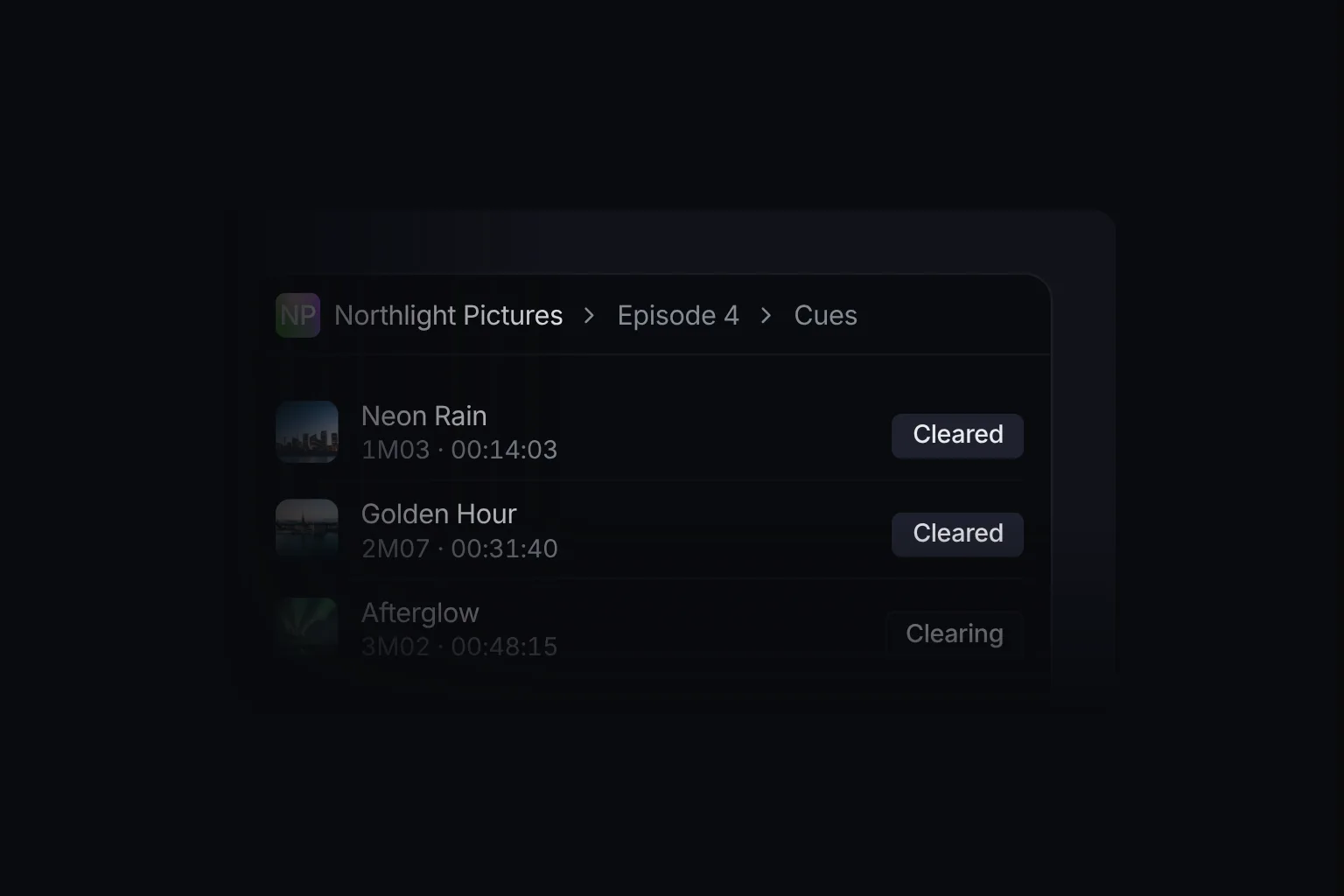
Performance royalties for a film or episode are paid from its cue sheet: the list of every cue with its duration, usage, writers, publishers and shares. If a cue is missing, its writer earns nothing from it. If an IPI number is wrong, the money waits until someone matches it by hand.
The cue sheet is usually made in the last, busiest week of post-production. Productions that collect writers and splits when each cue is commissioned or licensed, instead of after delivery, get it right the first time.
2. Keep them right
A film does not have one cut. A territory edit, an airline version, a director's cut, a series re-edited for a new platform: each one changes what airs, and each one needs its cue sheet revised. A re-score for a new market brings new writers who need to be on it.
3. Pay every writer what they are owed
The writer's share of performance royalties goes straight from the societies to the composers. Everything else goes through the owner of the music: the publisher's share, soundtrack streams and sales, licensing fees, and any income share in the composer agreements. That owner sends statements, usually per quarter or half year, and every writer and artist on them should be able to see what their music earned without emailing to ask.
A production with one score sends a few statements. A studio with a catalogue of series and films sends hundreds, each calculated against a different deal. See reading a royalty statement for what goes into them.
4. Put the music you own back to work
A production that owns its score owns a catalogue. Trailers, ads, games, other films and series license existing music all the time, and a cue written for one scene can fit another production's scene years later. Every new placement pays a licence fee, and every broadcast of it pays performance royalties to the writers again.
That only happens if someone pitches the catalogue: knows what is in it, which tracks are cleared for what, and answers briefs. A pipeline from brief to signed licence, with the tracks pitched against each brief, turns an archive into income. See how music clearance works for what a licensee asks for.
5. Keep the records
Every job above needs the same records: each cue's writers, splits, societies and IPI numbers, its ISRC and ISWC, every licence granted with its territories and term, every composer agreement, and every statement sent. Kept per film in folders on a shared drive, they are lost when the production team moves on. Kept with the music, they are there when the next territory edit, the next statement or the next brief arrives.
How long it lasts
As long as the copyright. In most countries that is 70 years after the death of the last surviving writer for the composition, and decades for the recordings. A series that airs in reruns or streams around the world can earn for its writers longer than most of them will work.
Aftercare in Aden
Aden is built for the years after the premiere:
- Every cue and song keeps its writers, roles, societies, IPI numbers and shares on its Collaborators tab, and its ISRC and ISWC in its details.
- An episode or film's music can be exported as a cue sheet CSV with the cue order, cue times, durations, ISRC and ISWC.
- Licences are recorded on each track with territories, term, fee and the signed agreement, with reminders before one expires.
- The catalogue is pitched from a pipeline that runs every brief from lead to placement, with the tracks pitched against it.
- Income is calculated per period against each deal, and every writer and artist gets a statement they open in Aden.
See Aden for productions for the whole picture, and Aden Business to set it up for your studio.
FAQ
What happens to film music after the movie is released?
It keeps earning. Broadcasts and streams pay performance royalties from the cue sheets, the soundtrack earns from streams and sales, and the owner of the music can license it to other productions. Someone has to keep the cue sheets right, pay the writers and pitch the catalogue.
How do composers get paid after a film comes out?
Through their collecting society, which pays the writer's share of performance royalties based on the production's cue sheets, and through the owner of the music, which pays any share of soundtrack or licensing income the composer agreement gives them.
Can a production license its film music to other projects?
Yes, if it owns the music, which it usually does for commissioned score. Trailers, ads, games and other productions license existing music, and each placement pays a fee and new performance royalties to the writers.
Who manages a film's music catalogue after release?
The owner of the music, usually the production company or its publishing arm, or a publisher or administrator it appoints. Their job is to file and correct cue sheets, send statements and license the music.
How long do film music royalties last?
As long as the copyright, which for compositions in most countries runs until 70 years after the death of the last surviving writer. Reruns and streaming keep long-running series earning for decades.
Less admin. More music.